To import goods from China to Pakistan, first define your product and import requirements, then find and verify the supplier and check the HS/PCT classification, import feasibility, and estimated landed cost before committing to the order. After that, confirm the order, prepare the documents, choose the right freight method, complete customs clearance in Pakistan, and arrange final delivery.
For B2B importers, many costly problems begin before the shipment leaves China. A clear process helps you identify supplier, quality, cost, documentation, and customs risks early rather than trying to solve them after the cargo is already in transit.

What Is the Step-by-Step Process for Importing from China to Pakistan?
A typical B2B import follows eight practical steps:
1. Define the product and import requirements. Confirm specifications, quantity, quality requirements, destination in Pakistan, and timeline.
2. Find a suitable supplier in China. Compare suppliers against the same requirements rather than price alone.
3. Verify the supplier and control quality. Use supplier checks, samples, audits, or pre-shipment inspection according to the order risk.
4. Check import feasibility and landed cost. Review HS/PCT classification, import requirements, Incoterms, freight, duties and taxes, and destination costs.
5. Confirm the order and shipment details. Align specifications, packaging, commercial terms, inspection requirements, and documents.
6. Choose the freight method. Select express, air, LCL, or FCL based on the cargo and required timeline.
7. Complete customs clearance in Pakistan. Submit the applicable declaration and documents and complete the assessment and release process.
8. Arrange final delivery. Move the released cargo to the warehouse, factory, project site, or other agreed destination.
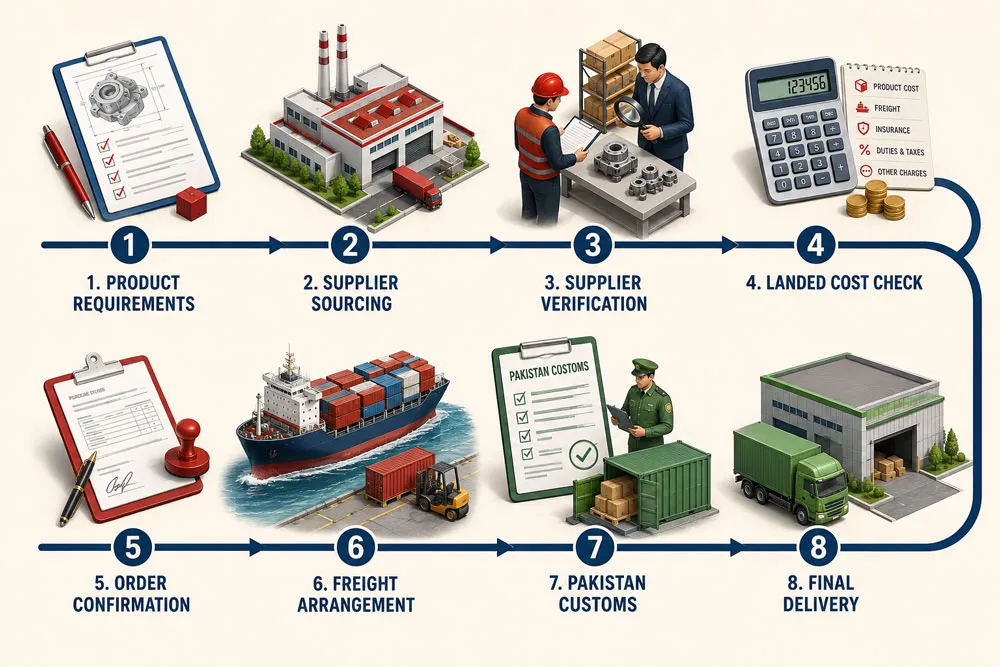
Treat these stages as one connected process. Decisions made during sourcing can directly affect freight costs, customs clearance, and your final landed cost.
What Should You Check Before Importing Goods into Pakistan?
Before requesting supplier or freight quotations, define exactly what you are buying. For industrial parts, machinery, electrical equipment, or other technical products, use drawings, model numbers, materials, dimensions, standards, tolerances, or datasheets where relevant rather than relying on a general product name.
Confirm the order quantity and purchasing pattern as well. A sample order, recurring purchase, and project-scale order may have different MOQ, packaging, inspection, and freight requirements.
You should also establish the delivery city in Pakistan and required timeline, then check whether the product may require special certificates, permits, packaging, carrier approval, or other supporting documents.
Before sourcing begins, you should be able to answer six questions: What exactly are you buying? How much do you need? What specifications must it meet? Where will it be delivered? When do you need it? And do you already have a supplier in China?
How Do You Find the Right Supplier in China?
The right Chinese supplier is not necessarily the one offering the lowest unit price. Compare suppliers against the same product specification and evaluate their ability to meet your quality requirements, quantity, lead time, packaging needs, and commercial terms.
Prepare a clear sourcing requirement that includes specifications, drawings or model numbers where relevant, quantity, quality standards, packaging, and required technical or compliance documents.
When comparing quotations, clarify the MOQ, production lead time, payment terms, packaging, customization, quotation inclusions, and documentation capability. For technical products, make sure the supplier understands the actual specification rather than offering a similar-looking substitute.
What If You Already Have a Supplier in China?
If you already have a suitable supplier, you can skip supplier sourcing but should still confirm the supplier details, specifications, commercial terms, production status, pickup location, packaging, and shipment requirements.
You can then arrange only the support you need, such as inspection, pickup, consolidation, international freight, customs-clearance coordination, or delivery in Pakistan.
How Do You Verify a Chinese Supplier and Control Quality?
Supplier verification, sample approval, and product inspection solve different problems. Verification assesses the supplier, samples help confirm the proposed product, and inspection checks the actual order before shipment.
Depending on the order risk, supplier verification may include reviewing the business license, relevant certifications, capabilities, export experience, and supporting company information.
For technical, customized, or unfamiliar products, check samples against an agreed specification. Depending on the product, this could include dimensions, materials, model numbers, functionality, workmanship, or labeling.
Higher-value or higher-risk orders may also justify a pre-shipment inspection based on a defined checklist. Independent third-party inspection can be used where appropriate.
Supplier Verification vs. Product Inspection
Check | Main Purpose | Typical Focus |
Supplier verification | Assess the supplier | Business identity, documents, capabilities, export experience |
Sample approval | Confirm the proposed product | Specification, materials, dimensions, function, workmanship |
Pre-shipment inspection | Check the actual order | Quantity, agreed quality criteria, packaging, labeling, visible defects |
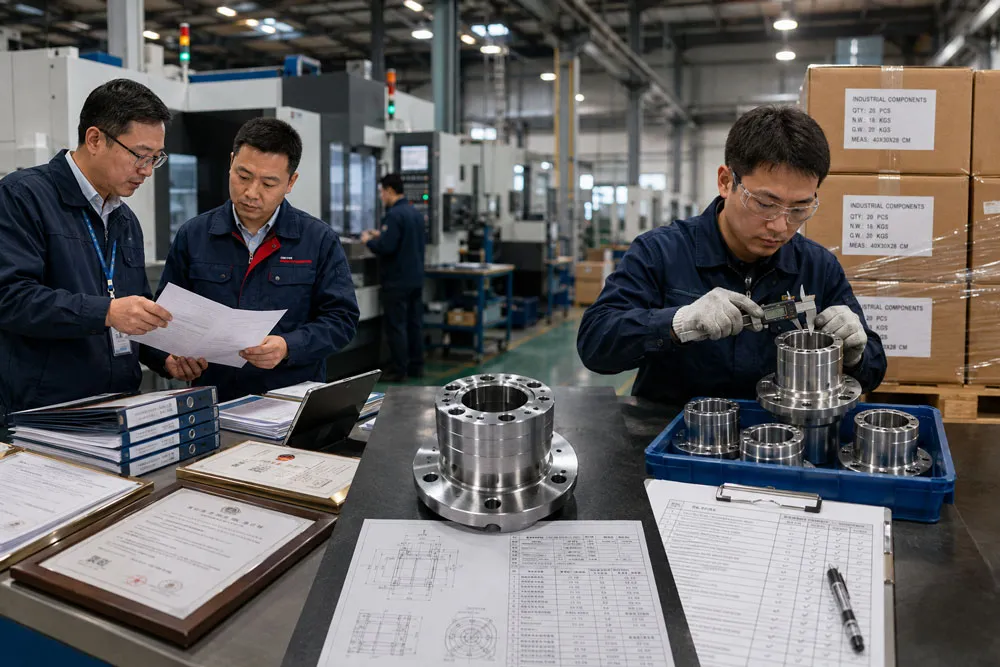
These controls reduce sourcing risk but do not guarantee future supplier performance or defect-free delivery. Match the level of control to the value, complexity, customization, and consequences of failure for the order.
How Do You Check Import Feasibility and Landed Cost Before Ordering?
Before making a major payment or confirming production, review the product’s likely HS/PCT classification, import requirements, Incoterms, and estimated landed cost. The goal is to determine whether the order still makes commercial sense after importing it into Pakistan.
HS/PCT classification can affect duties and taxes as well as product-specific requirements. Technical specifications, materials, function, and model information may be needed to review the likely classification; the supplier’s general product description may not be sufficient.
You should also understand the supplier’s Incoterm. EXW, FOB, and CIF quotations allocate costs and responsibilities differently, so supplier prices should not be compared without understanding what each quotation actually includes.
What Should Be Included in Landed Cost?
A practical planning calculation is:
Product cost
· China-side costs
· inspection where applicable
· international freight
· insurance where applicable
· Pakistan duties and taxes
· clearance and destination charges
· local delivery
· = Estimated landed cost
Additional collection, handling, or consolidation costs may apply to multi-supplier orders.
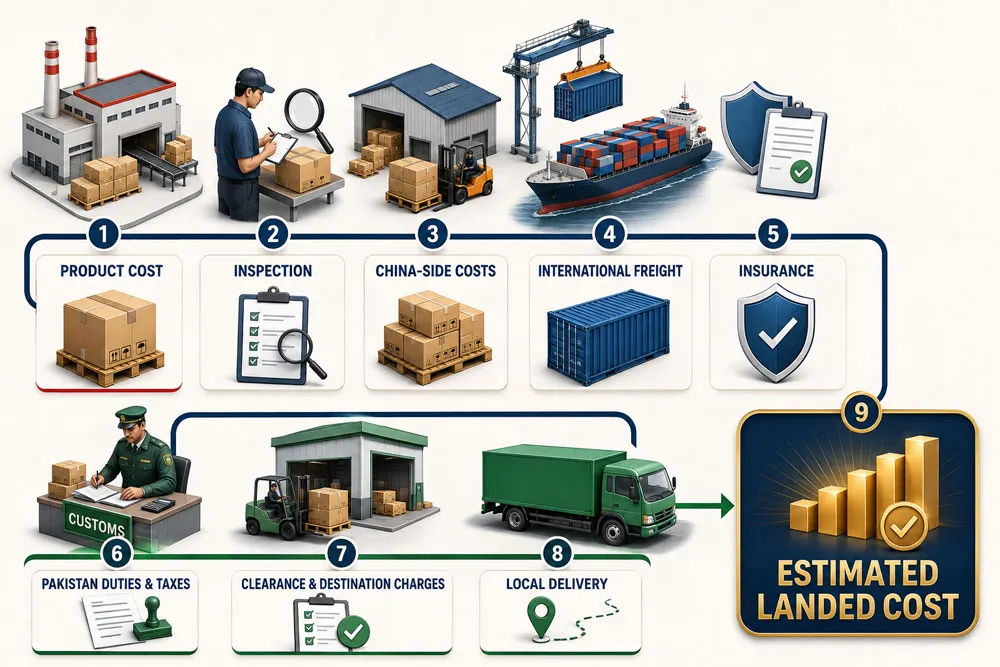
The key purchasing rule is to compare expected landed cost at your Pakistan destination, not factory price alone. A lower unit price can lose its advantage once packaging, freight, import charges, and destination costs are included.
Duty and tax figures should remain indicative until the product and shipment details are confirmed. Final classification and assessment are determined by the relevant customs authorities.
Use this calculation as a go/no-go check before committing to the order. If classification, documentation, shipping restrictions, or landed cost changes the business case, resolve the issue before production or major payment.
What Should You Confirm Before the Goods Leave China?
Do not release the shipment simply because production is finished. Confirm the goods, inspection status, packaging, commercial information, and required shipment documents together before dispatch.
Check the final quantity, specification, packaging, labels, and any agreed quality-control requirements. If an inspection was arranged, resolve material issues before shipment.
Common documents may include:
· Commercial invoice
· Packing list
· Bill of lading or air waybill
· Product-specific certificates, permits, or supporting documents where required
Descriptions, quantities, values, package counts, weights, and other relevant information should be consistent across the shipment records.
Not every product requires the same documentation. Product-specific requirements should therefore be confirmed before the cargo leaves China rather than assumed after arrival.
Which Shipping Method Should You Use from China to Pakistan?
Choose the shipping method based on cargo weight and volume, product characteristics, urgency, shipment size, and total logistics cost rather than the lowest advertised rate.
Before requesting a quotation, collect the gross weight, package dimensions, CBM, number of packages, product type, China pickup location, Pakistan destination, and required timeline.
Shipping option | Usually suitable for | Main decision factors |
Express | Samples and small urgent shipments | Speed, shipment size, restrictions |
Air freight | Time-sensitive commercial cargo | Weight, dimensions, chargeable weight, urgency |
Sea LCL | Cargo below full-container scale | CBM, consolidation, destination costs, timing |
Sea FCL | Larger or container-scale cargo | Volume, utilization, handling requirements |
Air Freight vs. Sea Freight
Air freight is worth considering when delivery speed has greater commercial importance and the cargo profile justifies the additional cost. Sea freight is generally more relevant for larger shipments when the importer can accept a longer logistics cycle.
Compare total logistics cost, including applicable pickup, consolidation, handling, destination, clearance, and local delivery charges—not international freight alone.
When Should You Consider LCL or FCL?
LCL allows smaller shipments to share container space, but consolidation and deconsolidation introduce additional handling and potential destination charges.
FCL may become more practical as volume increases or when greater handling control is important. There is no universal CBM threshold: compare actual quotations, cargo characteristics, routing, and destination costs.
For orders involving several Chinese suppliers, cargo may also be consolidated where the products, documentation, packaging, and schedules are compatible.
How Does Customs Clearance Work in Pakistan?
When the goods arrive in Pakistan, they must complete the applicable customs declaration, classification, assessment, and release process before final delivery.
In practical terms, the process generally involves:
1. Submit the shipment information and applicable documents.
2. Declare and classify the goods using the relevant product information and HS/PCT classification.
3. Complete the customs assessment for applicable duties, taxes, and requirements.
4. Provide additional documents, clarification, or inspection where requested.
5. Obtain customs release before destination delivery.
This is why customs preparation should begin before shipment. Inconsistent product descriptions, missing supporting documents, or incorrect assumptions about classification can create delays and additional destination costs.
A customs broker or import-support provider can coordinate the process and help review available documentation, but an indicative classification or duty estimate is not a final customs ruling. Final classification, assessment, inspection, document acceptance, and release decisions remain with the relevant Pakistan customs authorities.
How Does Door-to-Door Delivery from China to Pakistan Work?
Door-to-door shipping can connect China-side pickup, international freight, customs-clearance coordination, and delivery in Pakistan, but the exact scope must be confirmed before you accept the quotation.
What Should a Door-to-Door Quote Include?
Confirm responsibility for:
· Supplier pickup and China-side handling
· Consolidation where required
· International freight
· Shipment documentation
· Insurance where requested
· Customs-clearance coordination
· Import duties and taxes
· Destination charges
· Local transportation and final delivery
· Any exclusions
Do not assume that the phrase “door-to-door” automatically means the same responsibility structure as DDP. Confirm the applicable Incoterm, inclusions, exclusions, duties, customs responsibilities, and delivery scope in writing.
After customs release, final delivery will depend on cargo type, shipment size, destination, access requirements, and local operating conditions.
What Importing Mistakes Should B2B Buyers Avoid?
Most high-cost mistakes can be traced to five decisions:
1. Buying against an unclear specification. Define what the supplier must deliver before comparing quotations.
2. Choosing on price rather than landed cost. Include freight, import, destination, and delivery costs in the commercial decision.
3. Using insufficient supplier or quality controls. Match verification and inspection to the risk of the order.
4. Shipping before documentation is ready. Resolve inconsistencies while the goods are still in China.
5. Assuming estimates or service labels are guarantees. Confirm freight scope, customs responsibilities, duties, timing assumptions, and door-to-door inclusions.
Resolve uncertainty at the earliest stage where you can still act on it: supplier risks before payment, quality issues before shipment, document problems before dispatch, and import-cost questions before committing to the order.
Should You Import Yourself or Use a China-to-Pakistan Sourcing and Logistics Partner?
You can manage the import yourself if you already have a reliable supplier and the experience and resources to coordinate documents, freight, customs clearance, and delivery. More complex orders may benefit from specialized support.
Manage directly when you have established suppliers and reliable logistics and customs resources.
Use selected support when you only need specific services such as inspection, pickup, consolidation, freight, customs-clearance coordination, or local delivery.
Use an integrated workflow when a new supplier, multiple factories, technical products, quality control, or complex logistics require closer coordination across China and Pakistan.
CPSL Hub supports flexible China-to-Pakistan import workflows. Depending on the requirement, CPSL can coordinate China-side sourcing and supplier activities, verification and inspection arrangements, freight and documentation, Pakistan customs-clearance support, and delivery after customs release.
The important point is to define responsibilities before execution begins so supplier follow-up, inspection, freight, customs, and delivery do not fall between disconnected service providers.
Frequently Asked Questions About Importing from China to Pakistan
Can I import from China to Pakistan if I already have a supplier?
Yes. You can keep your existing supplier and arrange only the remaining services you need, such as verification, inspection, pickup, consolidation, freight, customs-clearance support, or delivery in Pakistan. Confirm the product, packaging, pickup details, documents, and service responsibilities before shipment.
Can I combine goods from multiple Chinese suppliers into one shipment?
Yes, when the cargo, timing, documentation, and shipping arrangements are compatible. Consolidation can simplify multi-supplier shipping, but collection, handling, storage, packaging information, and document coordination should be included when comparing the overall cost.
Should I inspect every order before it leaves China?
Not necessarily. Inspection should reflect the product value, technical complexity, customization, supplier history, and consequences of receiving non-conforming goods. New suppliers, customized products, machinery, engineered components, or high-value orders may justify stronger controls.
Can I know the exact customs duty before shipping?
You can obtain an indicative estimate after reviewing the product details, likely HS/PCT classification, customs value, origin, and current import requirements. However, the final classification and duty or tax assessment are determined by the relevant customs authorities.
Is DDP always the best option for importing from China to Pakistan?
No. DDP can reduce coordination work in some transactions, but suitability depends on cost transparency, cargo type, commercial terms, and the level of control you need. Compare the complete scope and responsibilities rather than choosing an option solely because it is described as DDP or door-to-door.
What happens if customs asks for additional documents or inspection?
You may need to provide additional information, supporting documents, clarification, or access for examination before release. This can affect cost and timing, which is why accurate product information and document preparation before shipment are important.
What information is needed for a China-to-Pakistan import quotation?
Provide the product name or link, specifications where relevant, quantity, supplier status, available package information, pickup location in China, delivery city in Pakistan, and required timeline. Also identify any inspection, certification, consolidation, insurance, or special-handling requirements.
Final Thoughts
Successful importing from China to Pakistan starts before the cargo moves. Define the requirement clearly, verify the supply side, check import feasibility and landed cost before committing, and then coordinate freight, customs clearance, and delivery as one connected process.
CPSL Hub can support selected stages or coordinate a broader China-to-Pakistan sourcing and import workflow, depending on your requirements. To assess your shipment, share your product link or specification, quantity, existing supplier status, delivery city in Pakistan, and required timeline.