Shipping from China to Pakistan does not have one fixed price. Your actual freight quote depends on the shipping method, cargo weight and volume, origin and destination, cargo type, and what services the quote includes.
A per-kilogram, per-CBM, or container rate is only part of the picture. To understand what your shipment will really cost, you need to know how the freight is calculated, which China-side and Pakistan-side charges are included, and which customs-related or delivery costs remain outside the quoted price.

How Much Does Shipping from China to Pakistan Cost?
There is no single shipping cost from China to Pakistan that applies to every shipment. A useful price can only be calculated after the cargo details, transport method, origin and destination, and required service scope are clear.
You may see China-to-Pakistan shipping rates quoted per kilogram, per cubic meter (CBM), or per container. These figures can help with initial planning, but they are not automatically comparable.
It helps to separate three cost levels:
Cost level | What it means | What may sit outside it |
Freight rate | A rate used to calculate a specific transport service | Origin handling, destination charges, customs-related costs, or delivery |
Freight quote | Charges included for a defined shipment and service scope | Items specifically excluded from the quotation |
Landed cost | A broader view of the cost of importing goods to a defined point | Costs outside your chosen landed-cost calculation |
This is why a low per-kg or per-CBM rate does not necessarily mean a lower total import cost. Before comparing prices, confirm what each quote covers and where the service starts and ends.
What Factors Determine Shipping Costs from China to Pakistan?
Shipping costs are mainly determined by your cargo profile, transport method, origin and destination, required timeline, and service scope. Two shipments moving between China and Pakistan can therefore receive very different quotes.
Weight and volume are major cost drivers. Dense cargo and lightweight but bulky cargo use transport capacity differently, which affects how they are charged.
Cargo type also matters. Batteries, dangerous goods, fragile equipment, oversized machinery, and other special cargo may require different packaging, documentation, handling, routing, or carrier approval.
Origin and destination affect the quote as well. Collection from a supplier or consolidation point in China can add origin-side costs. In Pakistan, the final delivery location can affect handling and inland transport requirements.
Urgency influences the available transport options. Time-sensitive cargo may justify air freight, while less urgent commercial shipments may have more sea-freight options. Current capacity, routing, and applicable surcharges can also affect the price.
Finally, consider the service scope. International freight alone should not be compared directly with a quotation that also covers supplier pickup, customs-clearance coordination, and local delivery.
Is Your Freight Charged by Weight, CBM, or Container?
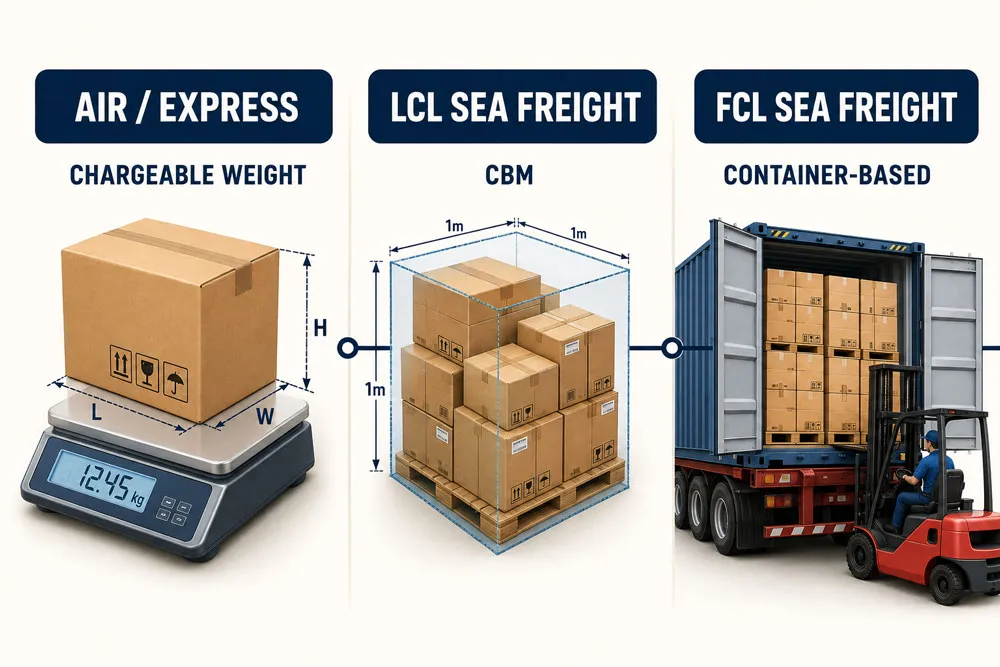
The charging basis depends on the shipping method and cargo profile. Air and express services commonly consider chargeable weight, LCL sea freight is typically driven by cargo volume and applicable weight conditions, while FCL is primarily quoted as a container service.
Shipping method | Typical charging basis | Information required |
Air / express | Chargeable weight | Gross weight and packed dimensions |
LCL sea freight | CBM or applicable chargeable basis | Package count, dimensions, volume, and weight |
FCL sea freight | Container-based pricing | Cargo volume, weight, and loading requirements |
Actual Weight vs. Volumetric Weight
Actual weight is what the shipment physically weighs. Volumetric weight reflects the space it occupies.
This matters for lightweight but bulky cargo. For air or express shipping, provide both gross weight and packed dimensions so the applicable chargeable weight can be determined. The exact volumetric calculation should be confirmed for the carrier and service being quoted rather than assuming one divisor applies to every shipment.
CBM for LCL Shipments
LCL cargo volume is commonly expressed in cubic meters, or CBM. The packed dimensions of the individual cartons, crates, or pallets are used to establish the shipment volume.
A per-CBM rate still does not represent the complete shipping cost. Minimum charges, cargo characteristics, origin handling, destination charges, and other service components may affect the final quotation.
Container-Based Pricing for FCL
With FCL, the required container service becomes the main pricing basis rather than simply multiplying a per-kg or per-CBM rate.
Cargo volume, weight, and packing still matter because they determine whether the goods fit the intended container and meet applicable loading requirements.
What Charges Are Actually Included in a China-to-Pakistan Freight Quote?
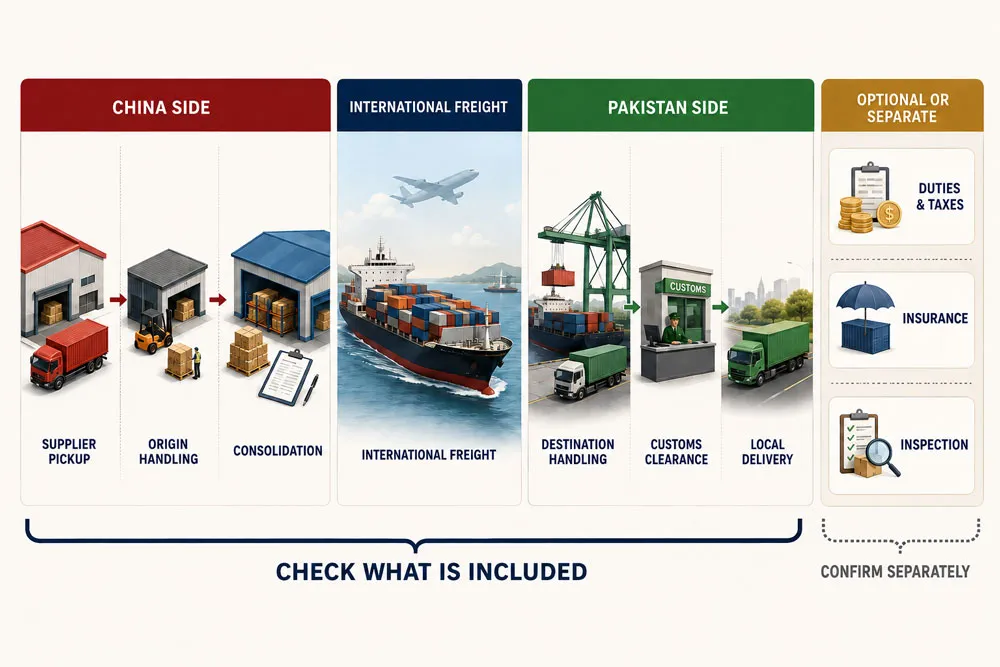
A freight quote may cover only international transportation, or it may extend from supplier pickup in China through customs-clearance coordination and delivery in Pakistan. Always confirm the quotation boundary before comparing the price.
Cost component | Always included? | What to confirm |
Supplier pickup in China | No | Whether collection from the supplier is covered |
Origin handling/documentation | No | Which China-side charges are included |
International freight | Core component | Mode, route, charging basis, and applicable surcharges |
Pakistan destination handling | No | Which arrival or handling charges are covered |
Customs-clearance service | No | Scope of clearance coordination |
Duties and taxes | No | Whether excluded, included under the agreed arrangement, or estimated |
Local delivery | No | Exact delivery point covered |
Optional services | No | Insurance, inspection, consolidation, or special handling |
China-Side Charges
Depending on the arrangement, China-side costs can include supplier pickup, cargo consolidation, origin handling, and shipment-document coordination.
This becomes particularly important with multiple suppliers. The international freight rate alone does not show what it costs to collect and prepare those shipments for export.
International Freight Charges
This is the main transport charge for moving cargo from China to Pakistan. Depending on the mode, it may be calculated using chargeable weight, CBM, or a container service.
The quote should clearly identify the transport service and relevant assumptions. A headline freight rate without a defined cargo basis and service scope is difficult to evaluate.
Pakistan-Side Charges
After arrival, destination handling, customs-clearance-related services, and inland delivery may apply. Whether these costs are included depends on the agreed quotation.
Even with a door-to-door service, confirm the exact delivery point and which Pakistan-side charges are covered.
Duties, Taxes, and Optional Costs
Customs duty and taxes should not be assumed to be included simply because a quotation covers shipping to Pakistan.
Duty and tax estimates may depend on the product, declared value, HS/PCT classification, origin, and current customs requirements. Any pre-shipment estimate should therefore be treated as indicative. The relevant Pakistan customs authorities make the final classification and assessment.
Optional costs such as insurance, inspection, or special handling should also be identified separately where applicable.
A useful quote makes its inclusions, exclusions, assumptions, and service boundary clear.
Should You Use Air, LCL, or FCL Shipping?
The most economical shipping method depends on cargo size, weight, urgency, handling requirements, and total service scope. Sea freight is not automatically the right choice for every shipment, and air freight should not be rejected solely because its headline freight rate is higher.
Method | Typical fit | Main cost consideration |
Air freight | Smaller or time-sensitive commercial cargo | Chargeable weight and service level |
LCL sea freight | Commercial cargo that does not require a full container | Volume plus applicable origin/destination charges |
FCL sea freight | Cargo suited to dedicated container space | Container service and associated route charges |
Air Freight for Smaller or Time-Sensitive Cargo
Air freight can make commercial sense when timing matters. For example, faster movement may be worth a higher freight charge when delayed components could affect production, a project milestone, sample approval, or inventory availability.
LCL for Smaller Commercial Sea Shipments
LCL lets your cargo share container space with other shipments, avoiding the need to book an entire container.
When comparing LCL with other options, consider more than the international per-CBM rate. Consolidation, handling, minimum charges, destination costs, and delivery requirements can affect the total.
FCL for Container-Scale Cargo
FCL becomes relevant when the cargo profile makes dedicated container space commercially sensible.
There is no universal CBM threshold at which FCL automatically becomes cheaper than LCL. The crossover depends on current freight rates, cargo dimensions and weight, container availability, origin and destination costs, and route conditions.
What Is the Difference Between Freight Cost and Landed Cost?
Freight cost reflects transportation under a defined shipping service. Landed cost takes a broader view of what the goods cost by the time they reach the defined import or delivery point.
A practical landed-cost framework may look like this:
Product cost + China-side costs + international freight + applicable insurance + duties and taxes + destination/clearance costs + inland delivery = broader landed cost
The exact calculation depends on your purchasing terms and where your business defines the landed-cost endpoint.
Customs-related costs require particular care. Duties and taxes can depend on the product, declared value, HS/PCT classification, origin, and current Pakistan customs requirements. An estimate can support planning, but the relevant customs authorities make the final assessment.
For a B2B importer, the better question is therefore not simply, “Which freight rate is lower?” It is, “What will each option cost across the parts of the import process my business is responsible for?”
What Does a Freight Quote Look Like in Practice?
A freight quote becomes easier to understand when you start with actual cargo information and follow the cost logic in sequence.
Consider an illustrative example: a Pakistan distributor has commercial goods ready at a supplier in China and needs them delivered to its business location in Pakistan.
1. Define the cargo.
Provide the product description, package count, packed dimensions, gross weight, and any special handling requirements.
2. Determine the charging basis.
For air freight, weight and dimensions help establish the applicable chargeable weight. For LCL, cargo volume and relevant weight conditions matter. For FCL, the container requirement becomes central.
3. Define the service.
Identify the China pickup point, Pakistan destination, transport method, and whether the service ends at a port or airport or continues through clearance coordination and delivery.
4. Check the cost components.
Confirm which China-side charges, international freight, Pakistan-side charges, and delivery costs are included.
5. Check the broader import cost.
Consider applicable duties, taxes, insurance, and other costs outside the freight quotation when planning landed cost.
The useful sequence is:
Cargo data → charging basis → transport option → quote components → landed-cost check.
If the final packing, pickup point, destination, or service scope changes, the quotation may also need to change.
How Should You Compare Two Freight Quotes?
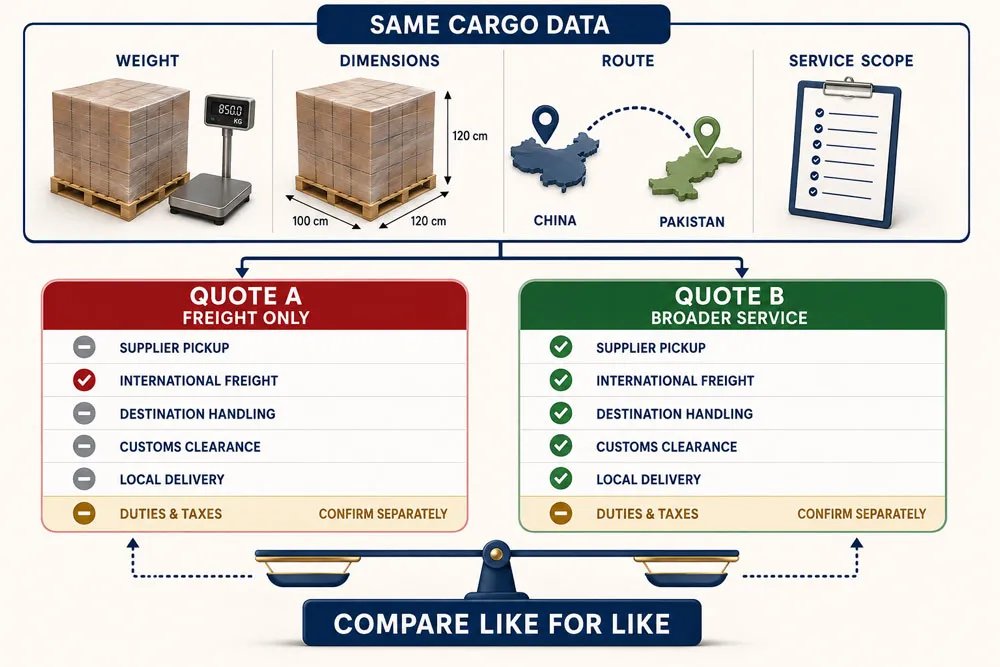
Two freight quotes are only comparable when they use the same cargo details, transport service, origin and destination, and cost responsibilities. A lower number may simply mean that one provider has excluded charges another has already included.
Use this apples-to-apples check:
1. Cargo data: Are package count, weight, dimensions, CBM, and cargo description the same?
2. Charging basis: Are both quotes using the same weight, volume, or container assumptions?
3. Transport service: Are you comparing equivalent air, LCL, FCL, or express services?
4. Origin and destination: Do both services start and end at the same locations?
5. Incoterm and responsibilities: Are supplier, buyer, and logistics responsibilities aligned?
6. Origin/destination charges: Are pickup, consolidation, documentation, handling, and applicable terminal charges treated consistently?
7. Customs clearance: Is clearance coordination included or excluded?
8. Duties and taxes: Are they excluded, included under the agreed arrangement, or only estimated?
9. Final delivery: Does the quote cover the same Pakistan delivery point?
10. Quote validity: Were the quotations issued for comparable market conditions?
Cost reduction should follow the same logic. Accurate packing data can prevent incorrect weight or volume assumptions. Consolidation may improve shipment planning for suitable multi-supplier orders, while choosing air, LCL, or FCL according to the actual cargo profile can avoid paying for an unsuitable service.
The objective is not simply to find the cheapest shipping from China to Pakistan. It is to find the required service at a sensible total cost without unclear exclusions creating unexpected charges later.
What Information Do You Need for an Accurate China-to-Pakistan Shipping Quote?
A meaningful quote requires enough information to identify the cargo, determine how it will be charged, plan the route, and define the service scope.
Prepare:
· Product description and specification, where relevant
· Quantity and package count
· Gross packed weight
· Packed dimensions
· Supplier or pickup location in China
· Delivery city in Pakistan
· Required timeline
· Incoterm, if known
· Required service scope, such as freight only or a broader door-to-door arrangement
· Special cargo requirements, including batteries, dangerous goods, fragile, oversized, or high-value cargo
· Supplier details, particularly when pickup or multi-supplier consolidation is required
For customs and landed-cost planning, the commercial invoice, declared value, detailed product information, and potential HS/PCT classification may also be required.
If the final weight, dimensions, pickup location, destination, or service requirements change after quotation, the price may need to be revised.
CPSL Hub can support China-side coordination together with freight, customs-clearance planning, and delivery coordination in Pakistan depending on the cargo and agreed service scope.
Frequently Asked Questions
Can I Get a Shipping Quote If My Supplier Is Already Selected in China?
Yes. If you already have a supplier, CPSL can assess support for pickup, consolidation where required, freight, documentation, customs-clearance coordination, and delivery depending on the service scope. Provide the supplier’s pickup location together with the final packing information and Pakistan destination.
Does a Door-to-Door Quote Include Customs Duty in Pakistan?
Not necessarily. Confirm whether duties and taxes are included, excluded, or only estimated in the specific quotation. Any estimate depends on shipment information, while the relevant Pakistan customs authorities make the final assessment.
Can Cargo from Multiple Chinese Suppliers Be Consolidated?
Yes, when the supplier locations, cargo, timing, and shipping plan make consolidation operationally suitable. Collection, consolidation, handling, document alignment, and onward freight should all be considered when evaluating the cost.
Can Batteries, Machinery, or Oversized Cargo Use General Cargo Rates?
Not automatically. Batteries, dangerous goods, oversized machinery, fragile equipment, and other special cargo may require additional packaging, documentation, handling, routing, carrier approval, or equipment. They should be reviewed before applying a general freight rate.
How Long Is a China-to-Pakistan Freight Quote Valid?
Use the validity period stated on the quotation. Freight rates, carrier capacity, routing conditions, and applicable surcharges can change, so an expired quote should be reconfirmed before booking.
Can the Final Customs Duty Differ from an Estimate?
Yes. Product information, declared value, HS/PCT classification, supporting documents, and current customs requirements can affect the final assessment. An indicative estimate should not be treated as a guaranteed customs amount.
What If My Cargo Weight or Dimensions Change After Quotation?
The quote may need to be recalculated. Changes to gross weight, packed dimensions, CBM, package count, or container requirements can affect both the charging basis and the most practical shipping option.
Final Thoughts
The best way to evaluate shipping cost from China to Pakistan is not to focus on the lowest per-kg, per-CBM, or container rate. First establish how the cargo is charged, what the quotation includes, and what costs remain before the goods reach your required delivery point.
CPSL Hub helps businesses coordinate China-side logistics with freight, customs-clearance support, and delivery in Pakistan through a connected workflow. For a case-specific assessment, share your product details, quantity, packed dimensions and weight, supplier location, delivery city, and required timeline.