A Pakistan import duty calculator is useful for estimating import costs before you place an order or ship goods, but its result should not be treated as the final amount Pakistan Customs will assess. To interpret the estimate correctly, you need to check the product’s PCT/HS classification, customs value, and the duties and taxes that may apply.
The key distinction is between calculation accuracy and input accuracy. A calculator can perform the arithmetic correctly while still producing a poor estimate if the classification, valuation basis, tax treatment, or another material input is wrong.
For commercial importers, the goal is not simply to get a number. You need to know what that number includes, which assumptions it depends on, and whether it is reliable enough for budgeting or landed-cost planning.

How Accurate Is a Pakistan Import Duty Calculator?
A Pakistan import duty calculator can provide a useful planning estimate when its inputs are reliable. It does not, however, determine the final amount assessed through the applicable customs process.
Three figures are particularly easy to confuse:
Result | What It Tells You |
Calculator estimate | An indicative amount based on the classification, customs value, rates, and other inputs used. |
Customs assessment | The amount determined through the applicable customs process for the actual shipment. |
Landed cost | The broader cost of getting the goods to the required destination, potentially including freight, duties and taxes, clearance, handling, local delivery, and other case-specific costs. |
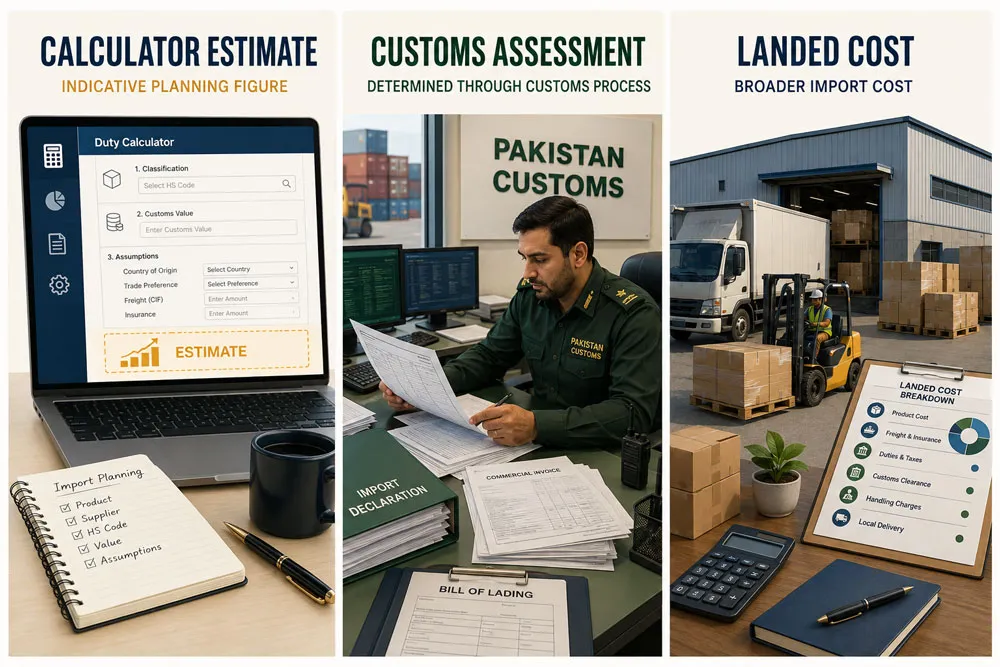
This distinction matters because a precise-looking total can create false confidence. If the PCT classification or valuation basis is wrong, the arithmetic may still be correct while the estimate is unsuitable for the shipment.
For B2B importers, use the calculator primarily for pre-import planning. Material assumptions should be verified before the result is used for a purchase order, customer quotation, or final landed-cost decision.
What Information Do You Need Before Using the Calculator?
Before using a Pakistan import duty calculator, you need enough information to identify the product, establish the calculation basis, and determine which duties and taxes may apply.
A practical way to prepare the inputs is to separate them into three groups:
Input Type | What to Prepare | Why It Matters |
Known information | Product description and specifications, quantity, supplier price, and country of origin | Establishes what is being imported and provides the starting point for classification and valuation. |
Calculated information | Freight, insurance where applicable, and relevant customs-value inputs | Can affect the value used to calculate applicable import charges. |
Information to verify | PCT/HS classification, applicable duty and tax treatment, and relevant importer-specific factors | Incorrect assumptions can materially change the estimate. |
Product identification deserves particular attention. Descriptions such as “machine parts,” “electrical equipment,” or “solar accessories” may be too broad for reliable classification. Model numbers, materials, functions, technical specifications, drawings, and datasheets can provide a stronger basis.
Also distinguish between information you know and information you have assumed. If the PCT code or valuation basis remains uncertain, keep the calculator result provisional.
Why Do the PCT Code and Customs Value Matter So Much?
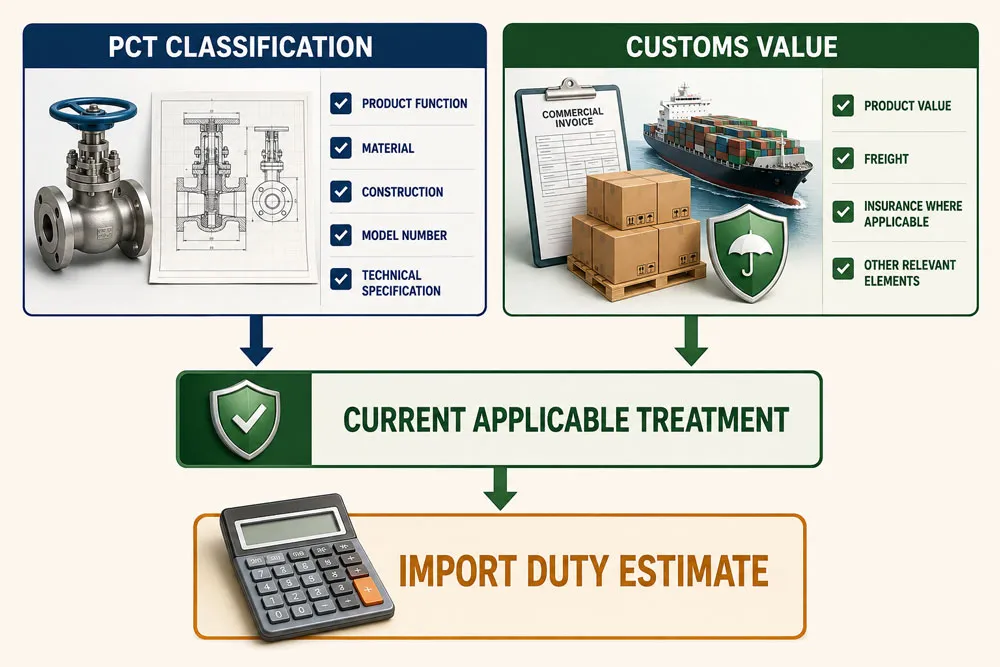
The PCT classification helps determine which tariff treatment may apply to your product, while customs valuation determines the value against which applicable duties and taxes are assessed. If either basis is wrong, the rest of the calculation can become commercially misleading.
Check the PCT Classification First
Pakistan uses PCT codes within its customs tariff to classify imported goods. Although importers often search using the broader term “HS code,” you should not choose a classification simply because a product name appears to match.
Classification may depend on factors such as material, function, construction, technical specifications, and intended use. Two commercially similar products can therefore require different classification treatment.
For industrial and technical goods, start with detailed product information. Datasheets, drawings, model numbers, materials, and functional specifications are more useful than a generic supplier description.
If classification remains uncertain, treat the duty estimate as provisional until the PCT assumption has been checked against current tariff information.
Then Check the Valuation Basis
The next question is what value the calculator is actually using. Entering only the supplier’s product price can be misleading if the calculation requires a customs value that includes other relevant elements.
Freight and insurance, for example, may be relevant when establishing a CIF-based value. The appropriate valuation treatment should be checked for the shipment rather than assumed from a generic online formula.
This also matters when comparing suppliers. A lower factory price does not necessarily produce a proportionally lower import-cost estimate if freight, insurance, classification, or other applicable charges differ.
Before relying on the total, verify two things: Is this the appropriate PCT classification for the product, and is the calculator using the appropriate valuation basis?
How Do You Calculate Import Duty in Pakistan Step by Step?
To calculate import duty in Pakistan, start with the product classification and appropriate customs-value basis, then apply the current duties and taxes relevant to the shipment. Do not simply find a duty rate and multiply it by the supplier’s invoice price.
A practical process is:
1. Identify the product accurately. Record its name, function, material, model, specification, and other relevant characteristics.
2. Confirm the relevant PCT classification. Check current Pakistan tariff information rather than relying only on a supplier-provided code.
3. Establish the appropriate customs-value inputs. Confirm the product value and relevant freight, insurance, or other valuation elements.
4. Check the current duty and tax treatment. Determine which duties, taxes, concessions, or other treatments may apply.
5. Enter importer-specific information where required. Some calculators request variables such as filer status because applicable import-stage tax treatment may differ.
6. Review the full breakdown. Check the components, rates or assumptions, and the value against which they were calculated instead of looking only at the total.
7. Record your assumptions. Keep the PCT code, valuation basis, rates, exchange-rate assumption, and calculation date with the estimate.
Consider two calculations using the same supplier price but different PCT classifications. Both calculations can be mathematically correct while producing different totals because the applicable tariff treatment differs.
For procurement purposes, a traceable estimate—with its classification, valuation basis, applicable rates, and material assumptions—is more useful than a calculator total with no explanation of how it was produced.
What Duties and Taxes Might Appear in the Result?
A Pakistan import calculation may include Customs Duty and other applicable import-stage duties and taxes, but not every component applies to every shipment. The actual treatment depends on factors such as PCT classification, current tariff and tax rules, and importer circumstances.
When reading the result, focus on what each line represents and why it appears.
Component | What the Importer Should Understand |
Customs Duty (CD) | Customs duty applicable to the product where required under its tariff classification. |
Additional Customs Duty (ACD) | Additional customs duty that may apply depending on the classification and current rules. |
Regulatory Duty (RD) | Additional duty that may apply to specified goods under prevailing regulatory treatment. |
Sales Tax | Import-stage sales tax treatment may form part of the calculation where applicable. |
Advance Income Tax | Applicable treatment can depend on current tax rules and importer circumstances. |
The total should not be interpreted as if several percentages were simply added together and applied to the supplier price. Different components may have different calculation bases, conditions, exemptions, concessions, or other applicable treatment.
For B2B cost planning, a calculator that shows its PCT code, value basis, applicable components, and rates is more useful than one that provides only a headline total.
Does Filer Status Change the Estimate?
It can where importer or filer status affects the applicable import-stage tax treatment. If a calculator asks whether the importer is a filer or non-filer, use the status relevant to the actual transaction rather than selecting an option simply to complete the calculation.
If the information is uncertain, record it as an assumption and keep the resulting estimate provisional.
How Can You Check Whether the Estimate Is Reliable?
Do not judge reliability by how detailed the calculator looks. Check the classification, valuation, applicable treatment, and timing behind the result.
Check | What to Verify | Warning Sign |
Classification | The PCT code matches the actual product and relevant specifications. | The code came only from a generic product name or an unverified supplier reference. |
Valuation | The calculation uses the appropriate customs-value basis. | Only the supplier price was entered without checking the required value basis. |
Applicable treatment | The duties, taxes, concessions, or other treatments are relevant to the shipment. | Rates came from an old article, previous shipment, or calculator default. |
Timing | Time-sensitive tariff, tax, exchange-rate, and related assumptions are current enough for the planned import. | The source does not indicate when its information was updated. |
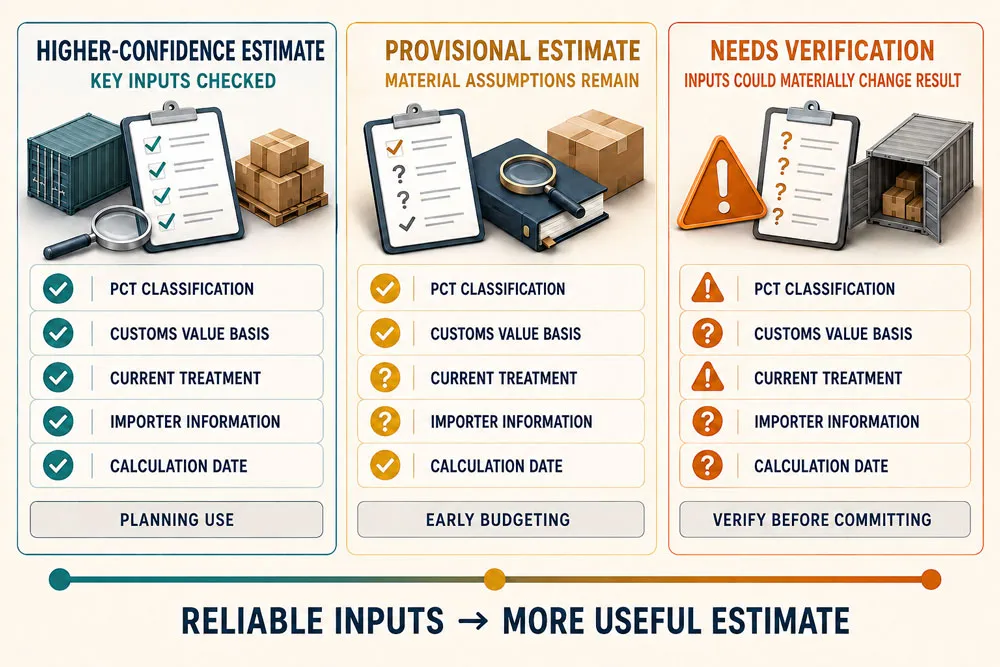
You can then classify the estimate by confidence:
Higher-confidence planning estimate: Key product, classification, valuation, and applicable-treatment assumptions have been checked.
Provisional estimate: One or more material inputs remain assumptions, but the figure is still useful for early budgeting or comparing sourcing scenarios.
Needs verification: Classification, customs value, or applicable treatment is uncertain enough that another reasonable assumption could materially change the result.
For procurement teams, this is more useful than asking whether a calculator is simply “accurate.” The better question is: How reliable are the inputs behind this estimate?
Why Can Customs Assess a Different Amount From the Calculator?
A customs assessment can differ from an online calculator even when the calculator performed its arithmetic correctly. The difference may come from classification, valuation, applicable duty or tax treatment, importer-specific factors, or time-sensitive inputs.
If the figures do not match, compare these assumptions first:
1. Product classification.
If the actual shipment is classified differently from the PCT code used in the calculator, the applicable tariff treatment may change.
2. Customs valuation.
The value used for an early estimate may differ from the valuation basis applied to the actual import.
3. Applicable duties and taxes.
A calculator may omit, include, or incorrectly assume a duty, tax, exemption, concession, or other treatment.
4. Importer-specific factors.
Where tax treatment depends on importer circumstances or status, an incorrect assumption can affect the estimate.
5. Timing and rate assumptions.
Tariff measures, tax treatment, customs exchange rates, and other time-sensitive inputs can change between initial costing and import.
When investigating a discrepancy, compare the PCT code, valuation basis, applicable duties and taxes, importer variables, and calculation date side by side instead of simply running the same figures through another calculator.
The final tariff classification, duty and tax assessment, document acceptance, inspection, and release decisions remain with the relevant Pakistan customs authorities.
What Should You Check Before Relying on the Result?
Before using the result for a purchasing or shipping decision, run a short pre-import check:
· Did you classify the exact product? Avoid relying on a PCT code selected only from a broad product description.
· Did you verify the value basis? Do not automatically treat the supplier price as the customs calculation base.
· Are the duties and taxes current and applicable? Avoid carrying rates or treatment from an old article or previous shipment into a new calculation without checking them.
· Did you check relevant importer variables? Use information applicable to the actual transaction.
· Are you treating an estimate as a final assessment? Keep those two concepts separate.
· Are you confusing duties and taxes with landed cost? Freight, clearance, handling, delivery, and other case-specific costs may still need to be included.
If a material answer remains uncertain, label the total provisional rather than turning it into a fixed purchasing or margin assumption.
Can You Use the Estimate for Landed-Cost and Purchase Decisions?
A Pakistan import duty estimate can support early budgeting, supplier comparison, and preliminary margin analysis. It should not be the sole basis for a final purchase order, fixed customer quotation, or landed-cost approval when material assumptions remain unverified.
When an Estimate Is Enough
An indicative estimate is useful for screening suppliers, comparing sourcing options, preparing an initial procurement budget, or deciding whether an import scenario is commercially worth pursuing.
At this stage, the figure needs to be appropriate for the decision—not presented as a confirmed customs amount.
For example, when comparing two suppliers in China, you can combine preliminary import estimates with product price and freight assumptions to see whether the difference materially affects the business case.
When You Should Verify Before Committing
Verification becomes more important when the figure will affect a large purchase order, fixed customer price, shipment approval, or thin-margin transaction.
Before committing, check the product specification, PCT classification, customs-value basis, current applicable duties and taxes, importer variables, and shipment assumptions. If a material uncertainty remains, resolve it or account for that uncertainty in your commercial calculation.
Remember that import duties and taxes are only part of landed cost. Depending on the shipment, the complete commercial calculation may also need to consider international freight, customs clearance, cargo handling, local delivery, insurance, storage, inspection, and other case-specific expenses.
For a China-to-Pakistan order, connect the duty estimate to the actual product and logistics plan before treating it as a working landed-cost figure.
Frequently Asked Questions
Can I calculate Pakistan import duty before my supplier ships the goods?
Yes. You can prepare a pre-shipment estimate if you have sufficient information about the product, PCT classification, value, origin, and shipment. Use it for planning, particularly while any material input remains provisional.
Can two similar products have different duty estimates?
Yes. Commercially similar products can have different classifications or tariff treatment because factors such as material, function, construction, and technical specifications may matter. Do not automatically apply one product’s duty estimate to another.
What should I do if I am unsure about the PCT code?
Keep the calculation provisional until the classification has been checked. Use detailed specifications, materials, functions, model numbers, datasheets, or drawings to support the review against current Pakistan tariff information.
Does the country of origin affect the duty estimate?
It can where tariff treatment, concessions, trade arrangements, or other requirements depend on origin and the relevant conditions are satisfied. Do not assume preferential treatment merely because goods are shipped from a particular country.
Can an exemption, concession, or special tariff treatment change the result?
Yes, where that treatment applies to the specific import. Generic calculators may not identify every exemption, concession, or case-specific condition, so eligibility and supporting requirements should be checked before relying on a reduced estimate.
Should I use the calculator result when quoting my customer in Pakistan?
You can use it as an input for a preliminary quotation, but avoid treating an unverified estimate as a fixed cost. If your price or margin depends materially on the result, verify the key classification, valuation, tax, and shipment assumptions first.
What information should I verify before requesting a landed-cost estimate?
Verify the product and specification, quantity, supplier price, PCT/HS assumptions, origin, shipment details, delivery destination, and relevant special requirements. Depending on the shipment, a complete landed-cost estimate may also need freight, clearance, handling, insurance, local delivery, and other case-specific costs.
Final Thoughts
A Pakistan import duty calculator is most useful when you treat its result as a traceable estimate rather than a guaranteed customs figure. Before using it for a purchase, quotation, or landed-cost decision, make sure the classification, valuation basis, applicable duties and taxes, and shipment assumptions are reliable enough for that decision.
For China-to-Pakistan imports, CPSL Hub can support HS/PCT review, indicative duty and tax estimation, freight planning, customs-clearance coordination, and delivery planning through a connected import workflow.
If you are evaluating an actual shipment, share your product name or specification, quantity, supplier details, delivery city in Pakistan, and required timeline so the relevant import and landed-cost assumptions can be reviewed for your project.